Correct Option -2

forum Community Discussion
No discussions yet. Be the first to start!
You must be logged in to participate in the discussion.
login Login to Discussauto_awesome Similar Questions
Concept:
- Water Harvesting: Water harvesting is a practice to conserve water by collecting rainwater in an organized way.
- The rainwater is not allowed to flow and get wasted but collected in tanks.
- The main purpose however is not the collection but the enhancement of groundwater level.
- The collected water through tubes is made to recharge groundwater.
- Maintenance of groundwater is long term sustainable structure for water conservation.
Here the logic is the methods which consumes water:
Explanation:
Kneading:
- Kneading is a process in the making of dough by mixing water and flour.
- Example: Kneading dough for roti.
- Consumes water
Swimming also need water to do so.
Washing clothes is also a process that consumes.
While combing hair, no need of water.
The correct answer is Rice.
- Rice blast disease, caused by Magnaporthe oryzae (Ascomycota), occurs in about 80 countries on all continents where rice is grown, in both paddy fields and upland cultivation.
- The extent of damage caused depends on environmental factors, but worldwide it is one of the most devastating cereal diseases, resulting in losses of 10–30% of the global yield of rice.
- Other common diseases of the crop of rice are - Blight, Bacterial leaf streak, Brown spot, Sheath blight, False smut, etc.
 Additional Information
- The biological agents that causing diseases to plants are known as pathogens.
- Some of the viral diseases in plants are - bud blight (soyabeans), Curly tops (Beans, tomato, etc.), Mosaic leaf (Tomato, pea, potato,tobacco, etc.).
- Some of the bacterial diseases in plants are - Blights (vegetable crops), Bacterial wilts (Tobacco, potatoes, etc), Cankers (Woody plants), Leaf Spots, Soft Wrots, etc.
- Some of the fungal diseases in the plants are - Cankers, Ergot, Rusts, Root rots, Scabs, Smuts, etc.
The correct answer is Uttar Pradesh.
 Key Points
- Uttar Pradesh
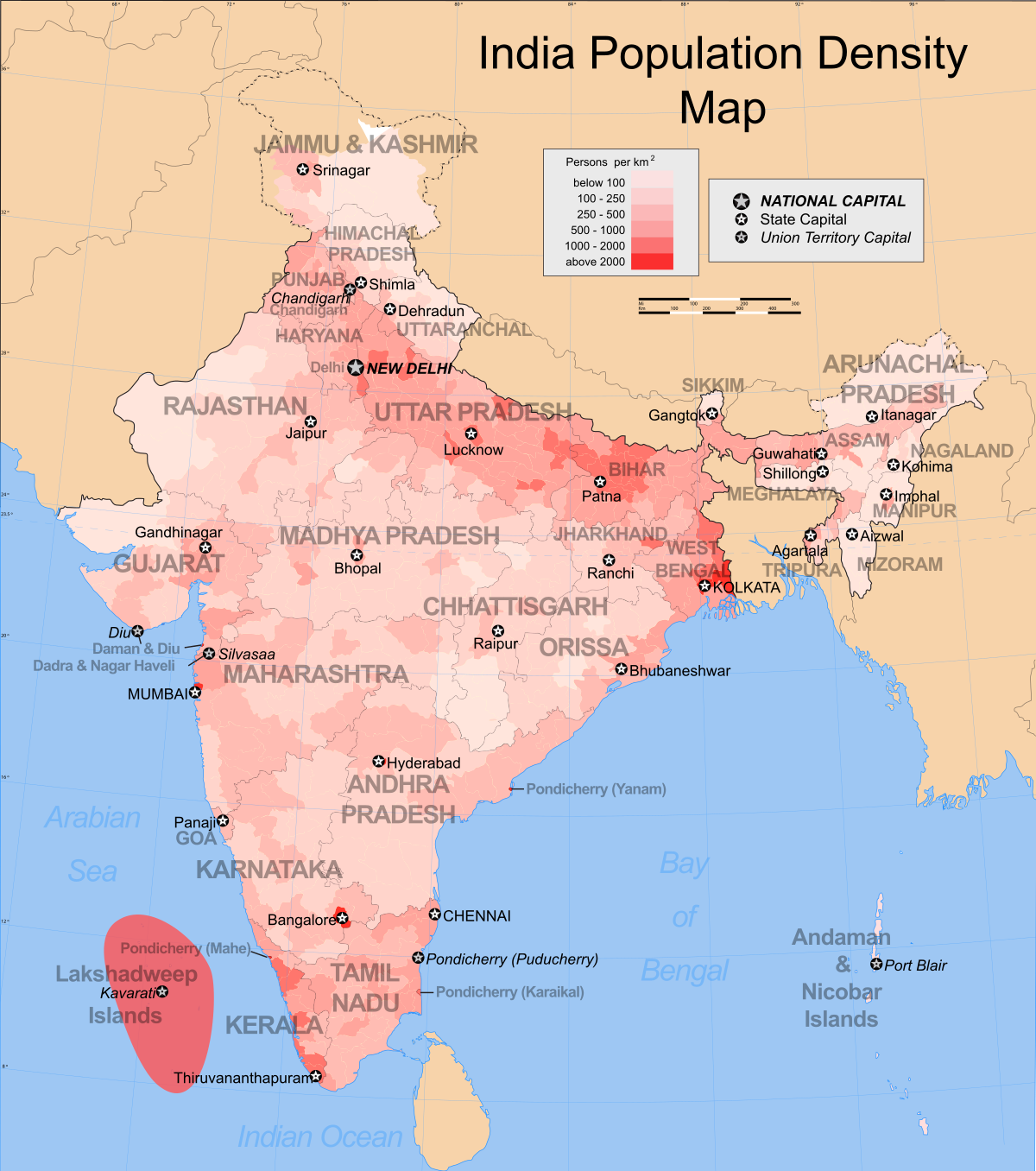
- Uttar Pradesh is the most populous state in India, with 199,581,477 people as of 1 March 2011. Hence, Option 4 is correct.
- The state contributes 16.16 percent of India's population
- The population density is 828 people per square kilometer, making it one of the most densely populated states in the country
- The sex ratio in 2011 was 908 women to 1000 men, lower than the national figure of 933
- Estimates released by the Planning Commission for the year 2009-10 revealed that Uttar Pradesh had 59 million people below the poverty line, the most for any state in India
- Hindi is the official language as well as the mother tongue of many in the state.
- Urdu, additionally an official state language, is primarily spoken by Muslims.
Additional Information
- Largest State in India by Population
-
S. No.
State Name
Population (As per Census 2011)
1
Uttar Pradesh
199,812,341
2
Maharashtra
112,374,333
3
Bihar
104,099,452
4
West Bengal
91,276,115
5
Andhra Pradesh
84,580,777
6
Madhya Pradesh
72,626,809
7
Tamil Nadu
72,147,030
8
Rajasthan
68,548,437
9
Karnataka
61,095,297
10
Gujarat
60,439,692
Map of India Population Density:
The correct answer is Vitamin B1.
Key Points
- When rice is produced and not polished it is called brown rice.
- Brown rice is rich in Vitamin B1.
- When brown rice is polished, rice loses many vitamins and minerals including Vitamin B1 through the bran.
- Vitamin B1 also called thiamine is an essential vitamin, a deficiency of which is known to cause beriberi.
Additional Information
| Vitamin Deficiency | Disease Caused |
| Vitamin A | Night blindness |
| Vitamin B2 | Retarded growth, Skin related problems |
| Vitamin B12 | Anemia, muscle and nerve-related problems |
| Vitamin C | Scurvy |
| Vitamin D | Rickets |
| Vitamin E | Cystic fibrosis, Crohn's disease |
| Vitamin K | Inability of Blood-Clotting |
In which year was the 'State Assessment Organization' established in Rajasthan?
The correct answer is In 1960.
- In 1960, the 'State Assessment Organization' was established in Rajasthan.
Key Points
- The State Evaluation Organisation was set up in the State on 1st April 1960.
- It was set up with the objective of undertaking evaluation of Panchayati Raj and Community Development Programme, and further assigned the task of making an evaluation of development schemes/ projects initiated under different Five Year Plans.
- Presently it is working as an integral part of the State Planning Machinery and conduct the evaluation studies on various subjects, schemes, projects and programmers as required by the State Government as well as by the Central Government.