MCQ
Q.
The smallest unit of the life capable of independent existence is:
Correct Answer: C
The correct answer is Cell.
 Key Points
- Cell:
- A cell is the smallest unit capable of independent existence which can reproduce itself. Hence, Option 3 is correct.
- All living organisms, except for viruses, are composed of one or more cells.
- Single-cell organisms; such as, bacteria, protozoa, and other micro-organisms are termed unicellular, while plants and animals that contain many cells are termed multicellular.
- Highly complex organisms; such as, human beings consist of billions of cells, all of which are adapted to carry out specific functions; for example, groups of these specialized cells are organized into tissue and bodily organs.
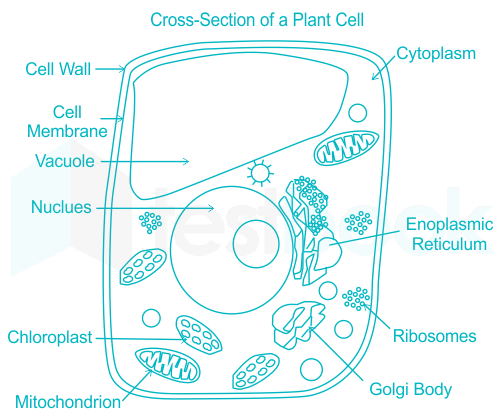
- Although cells may differ widely in size, appearance, and function, their essential features are similar.
 Important Points
- Almost all cells perform biochemical processes, generate and process energy, and store genetic information to be passed down to future generations of cells.
- Advanced single-celled and multicelled organisms have nuclei that carry the DNA, primitive cells; such as, bacteria, have no nucleus and carry their DNA loosely in coils throughout the cells
- The number of cells in an organism varies; for example, bacteria are single-celled organisms; the average adult human body has about one hundred trillion cells.
- Cells are the structural unit of all organisms and come in a range of sizes and shapes.
- Animal cells contain only an outside cell membrane.
- In most fungi, bacteria, and plants; there is a rigid cell wall outside the membrane.
- Each cell is composed of a mass of jelly-like substance called the cytoplasm, surrounded by a membrane.
 Additional Information
| Protoplasm | It is the cytoplasm and nucleus of a cell. |
| Cytoplasm | It is a thick solution that fills each cell and is enclosed by the cell membrane. |
| A vacuole | It is a membrane-bound cell organelle. |
