MCQ
Q.
The positive pole of the dry cell is made up to
Correct Answer: B
Concept:
- Any battery (actually it may have one or more than one cell connected in series) or cell that we use as a source of electrical energy is a galvanic cell where the chemical energy of the redox reaction is converted into electrical energy.
- In the primary batteries, the reaction occurs only once, and after use over some time battery becomes dead and cannot be reused again.
- The most familiar example of this type is the dry cell (known as Leclanche cell after its discoverer) which is used commonly in our transistors and clocks.
- The cell consists of a zinc container that also acts as anode and the cathode is a carbon (graphite) rod surrounded by powdered manganese dioxide and carbon.
- The space between the electrodes is filled by a moist paste of ammonium chloride (NH4Cl) and zinc chloride (ZnCl2).
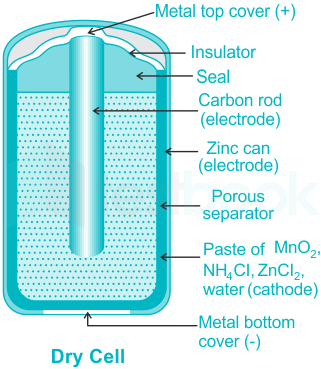
Explanation:
- The cell consists of a zinc container that acts as the anode.
- The cathode is a carbon (graphite) rod surrounded by a cathodic material powder of manganese dioxide and carbon.
So, The positive pole of the dry cell is made up of C (carbon).

