MCQ
Q.
A group of interconnected food chains is called
Correct Answer: C
 Key Points
Food chain:
- A food chain shows the feeding relationship between different organisms in a particular environment and/or habitat.
- A food chain shows how energy is passed from the sun to producers, from producers to consumers, and from consumers to decomposes such as fungi.
- They also show how animals depend on other organisms for food.
- A simplified food web illustrating a three-trophic food chain (producers-herbivores-carnivores) linked to decomposers.
 Key Points
Food Web:
- A food web is similar to a food chain, but the food web is significantly larger.
- Occasionally, a single organism is eaten by a large number of predators, or it consumes a number of other species.
- As a result, several trophic levels become intertwined, and the food chain fails to accurately depict the flow of resources.
- The food chains are very simple and hence, do not exist in reality,
- Rather, an interconnection of many food chains is seen in nature or in our ecosystem that forms a food web.
- The energy flow is multidirectional.
- In a food web, one organism takes place at different trophic levels in different food chains (which combine to form a complex food web).
- It gives greater stability to the ecosystem.
Thus, a group of interconnected food chains is called a food web.
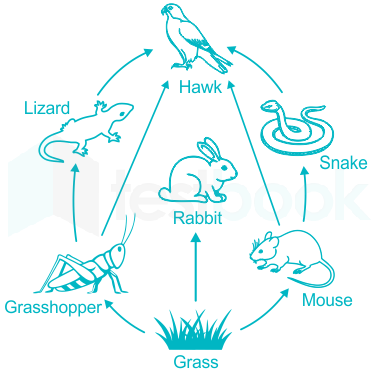
 Additional Information
Pyramid of Biomass:
- A biomass pyramid is a diagram that compares the biomass of different trophic levels within an ecosystem.
- It shows the mass of producers that are needed to support primary consumers, the mass of primary consumers required to support secondary consumers, and so on.


